Corporate Services Contact Us

Cheque Bounce Legal Services

Our team is dedicated to securing your financial rights in cheque bounce cases and walking you through the legal process. Having experience with cases under the Negotiable Instrument Act, our cheque bounce lawyers help with the preparation of legal notices and the management of legal cases when the case is related to the recovery of dues or defending the case.

Legal Advice & Case Evaluation
  • One-on-one consultation about the incident
  • Assessing whether the bounced cheque qualifies under Section 138 NI Act
  • Advising on the strength of the case and possible outcomes
  • Estimating legal costs and court timelines
Drafting Legal Notices
  • Preparing statutory demand notices to the drawer/drawee
  • Drafting notices with correct legal language and timelines
  • Ensuring notices comply with Section 138 requirements
  • Serving notices through registered post or a process server
Filing Criminal Complaints
  • Drafting and filing a FIR or a complaint in the appropriate magistrate's court
  • Preparing charge sheets and supporting documents
  • Representation during the initial stages of criminal proceedings
  • Filing complaints for cheque bounce cases across jurisdictions
Representation in Magistrate Courts
  • Court appearances during hearings
  • Cross-examination of witnesses and defendants
  • Submission of evidence, bank records, and legal arguments
  • Follow-through to final judgment
Civil Suit Support
  • Filing civil suits for the recovery of money due
  • Drafting plaints and written statements
  • Managing civil evidence and case hearings
  • Coordinating parallel civil and criminal proceedings
Bail Applications
  • Preparing and filing bail petitions for accused parties
  • Arguing for bail before the courts
  • Securing interim and regular bail when appropriate
Negotiation & Settlement
  • Leading out-of-court negotiations to settle cheque disputes
  • Drafting settlement agreements between parties
  • Advising on terms that protect your legal rights
  • Mediating between parties to avoid lengthy litigation
Appeal & Higher Court Representation
  • Filing appeals against lower court decisions
  • Representing clients in the Sessions Courts, High Courts, or the Supreme Court
  • Preparing detailed legal briefs and arguments for higher judiciary
Enforcement of Court Orders
  • Assisting with attachment of property orders
  • Enforcing recovery of amounts awarded by courts
  • Coordination with civil courts for execution proceedings
Documentation & Procedural Compliance
  • Preparing statutory forms, affidavits, and annexures
  • Ensuring all filings meet legal requirements
  • Handling service of process and summons compliance
Advisory on Preventive Measures
  • Guidance on how to avoid cheque bounce situations
  • Helping draft stronger payment instruments and agreements
  • Advice on contract clauses for future transactions
Corporate Cheque Bounce Services
  • Handling cheque bounce issues for companies and startups
  • Advising boards and management on exposure and liability
  • Corporate negotiation and settlement strategies
Bank Liaison & Evidence Collection
  • Coordinating with banks for cheque return memos
  • Procuring bank statements and reconciliation certificates
  • Organizing documentary evidence for court
Multiple Cheque / Series Handling
  • Managing cases where several cheques have bounced
  • Structuring legal strategy for serial cheque bounces
  • Grouping related cases for efficient litigation

How We Work

vidhikarya calendar icon1
Appointment
Fix up an appointment with the advocate for a detailed discussion on your matter.
vidhikarya strategic planning icon2
Strategic Planning
Advocate strategizes and plans the required legal action for your matter. Get expert legal guidance.
vidhikarya execution icon3
Execution
Advocate executes the legal action required on your matter along with association of expert pool of lawyers.
dedicated case manager support

Dedicated Case Manager Support Available From 10 am to 7 pm

Dedicated Case Manager Support Available
From 10 am to 7 pm

We handle Cheque Bounce cases in following courts in Kolkata

  • courtChief Metropolitan Magistrate Kolkata
  • courtChief Judicial Magistrate Court Barasat
  • courtChief Judicial Magistrate Court Alipore
  • courtBankshall Court
  • courtCMM Court
  • courtCJM Court
  • courtCJM Court Sealdah
  • courtCJM Court Barrackpore
  • courtCJM Court Baruipur

Get in Touch

phone

Phone Consultation

Quick legal guidance over a secure phone call.

video

Video Consultation

Face-to-face legal consultation from anywhere.

email

Email Consultation

Send documents and get written legal advice.

in-persion

In-Person Meeting

Detailed consultation at our office.

Frequently Asked Questions

What legal repercussions follow the presentation of a cheque that has been dishonoured?

Where a cheque is dishonoured for whatever reasons arising from insufficient funds or stopped payment, the drawer of the cheque incurs legal repercussions under Section 138 NI Act including fines and imprisonment.

Can I make a complaint for a cheque bounce for a post-dated cheque?

Yes, it is possible to file a complaint for dishonour of a post-dated cheque either in cases when the cheque is given after the date mentioned on it and is returned due to lack of funds etc. But the complaint has to be filed only after the date on which the cheque has been returned.

Can the complaint involve only a small cheque or is it limited to a certain amount?

That is, the NI Act does not contain any prohibition with regard to the maximum amount of the cheque in dishonour cases. However, it is also significant in the aspect of the cost-effectiveness of suing for smaller amounts.

What is available to a payee if the drawer fails to reply to a demand notice?

Since the drawer is given 15 days to respond to the demand notice, if there is no response, the payee can immediately make a complaint to the appropriate magistrate’s court.

What are the time constraints for filing a cheque bounce complaint?

Of course, action in the nature of a complaint must be instituted after 30 days from the end of the 15-day period after the demand notice has been issued. Such delay may cost the right to seek legal redress in many cases if done beyond the set limit.

What legal remedy is available to a drawer who believes that the cheque has been dishonoured unfairly?

Any drawer finding that a cheque was dishonoured without merits should approach his or her bank for an explanation. where unsatisfied they can approach the banking ombudsman or seek legal redress for further action.

What should I do if I receive a cheque bounce notice?

Respond promptly to the notice and settle the payment to avoid legal proceedings.

How long does it take to resolve a cheque bounce case?

Cheque bounce cases typically take 6 months to a few years, depending on court proceedings and settlement negotiations.

Is getting bail in Section 138 case in Kolkata court difficult.

No, its not difficult if you engage the top cheque bounce advocate in Kolkata and fulfil all the conditions of the bail and bond.

CONTACT USVidhikarya Contact Us

Contact Information

Vidhikarya Contact Icon
Call Us

7604047601 / 7604047602 / 9831397506 / 8100091175

Vidhikarya Contact Icon
Visit Us

No. 4, 2nd Floor,Esplanade Mansion, 14/16 Government Place (East), Kolkata-700069 Opposite Raj Bhawan (Governor’s House)

F-163, First Floor, Block C, Downtown Mall, Action Area III, Newtown, Kolkata-700160

GET IN TOUCH

Have Question?

Submit your details below, our expert legal team will check and get back to you

How do you avoid Cheque Bounce cases?

Cheques are an accepted mode of payment in India and are used for personal and business transactions. But when the cheque is defined as ‘bounced’, it can open a financial and legal disaster in their financial affairs. Cheque bounce according to the Negotiable Instruments Act (NI Act), 1881 or specifically Section 138 of the Act is a criminal offence provided some conditions are met. There is a clear legal framework in cheque dishonour cases to penalise the issuer who fails to meet his payment obligations. You can avoid Section 138 NI Act cases by ensuring that all EMI payments are paid in time and there is sufficient balance in the account.

What Is Cheque Bounce?

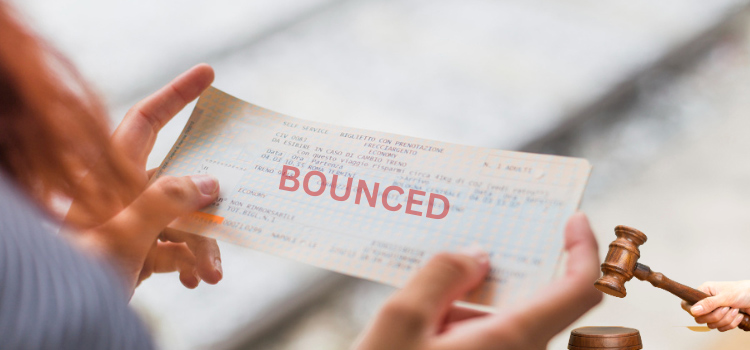
Cheque bounce or dishonour is when a bank returns a cheque for various reasons including lack of sufficient funds, a forged signature, overwritten or account issues. In case the cheque is returned unpaid, the bank gives the payee a “Cheque Return Memo” which among other things gives the reason for the return. This memo acts as a framework from which the payee can write to the drawer demanding his payment and in the event of the drawer’s failure, can proceed with legal action.

Common Reasons For Cheque Bounce

Cheque bouncing has become a common problem in recent years mainly due to the following causes:

Why my cheque bounce case is in Kolkata although I took loan in another city?

Even if you have taken loan in a city other than Kolkata but the bank or NBFC has its head office in Kolkata and thus the case has been filed in the court in Kolkata.

Why is cheque bounce such a grave offence in India?

Cheque bounce is regarded as a criminal offence mainly because any loss-making business or individual is likely to lose his/her money, and repeated dishonours are likely to impact the proper flow of business. According to Section 138 of the NI Act, to maintain the trust and accountability of cheque payments it has prescribed a criminal offence.

What is cheque bounce, civil or criminal? 

Cheque bounce is a criminal offence under Section 138 of the Negotiable Instruments Act which can involve punitive measures such as fines or imprisonment. But the payee can still seek other civil redressable remedies that would entitle the payee to monetary recovery.

Is a bounced cheque an automatic criminal affair?

Not immediately. Under Section 138, the act becomes a criminal offence only if the payee has followed the complaint process and the drawer has not paid within the stipulated period

What is the objective of Section 138?

Section 138 was intended to curb the misuse of cheques by those who make cheques for reasons prohibited under the NI Act.

Legal Consequences of Cheque Bounce

If found guilty under Section 138, the drawer may face the following penalties:

Additional Consequences

Credit impact: While it is not utilized in the calculation of credit scores, it influences the drawer’s credit with the banking and financial institutions.

Disclaimer

The Bar Council of India does not permit advertisement or solicitation by advocates in any form or manner. By accessing this website (www.vidhikarya.com), you acknowledge and confirm that you are seeking information relating to VIDHIKARYA LEGAL SERVICES LLP (The LAW FIRM) of your own accord and that there has been no form of solicitation, advertisement or inducement by VIDHIKARYA LEGAL SERVICES LLP or its members.
The content of this website is for informational purposes only and should not be interpreted as soliciting or advertisement. The User agrees that he/she is visiting the site on his own volition to seek more information about the firm and its Advocates.
The contents of this website are the intellectual property of VIDHIKARYA LEGAL SERVICES LLP.

Vidhikarya Official support e-mail Contact Vidhikarya by phone Number vidhikarya whatsapp Number